 How-to
How to Remove Graffiti From Brick Walls
Table of Contents
- What You'll Need Before Starting
- Assess Your Brick Type and Surface Condition
- Test Your Chosen Method on a Small Area
- Best Graffiti Remover for Brick: Choosing the Right Product
- Pressure Washing Graffiti Off Brick: Method and Risks
- How to Remove Old Graffiti From Brick: Multi-Step Approach
- How to Prevent Graffiti on Brick Walls
- Common Mistakes to Avoid
- Frequently Asked Questions
Last Updated: October 7, 2026
What You'll Need Before Starting
Learning how to remove graffiti from brick requires the right safety gear and tools first, skipping this risks your health and wastes time.
Safety Equipment and Protective Gear
Graffiti removers contain harsh chemicals that burn skin and damage eyes. Wear gloves, eye protection, and a chemical-rated respirator.
Essential safety gear includes:
- Heavy-duty rubber gloves (nitrile won't protect you)
- Safety glasses or face shield
- Respirator mask or chemical-rated cartridge mask
Work in a well-ventilated area, and always wear a respirator in enclosed spaces.
Graffiti Removal Tools and Materials
You need specific tools to remove graffiti from brick effectively, a soft cloth or pressure washer alone won't work.
Gather these items before you start:
- Graffiti remover product (solvent-based or eco-friendly)
- Stiff-bristled brush or nylon scrub brush
- Spray bottle or pump sprayer
Assess Your Brick Type and Surface Condition
Old brick is more porous and fragile than new brick, which is denser and more chemical-resistant. Cracks, missing mortar, or prior water damage mean extra care, harsh chemicals worsen existing problems, and pressure washing pushes water into cracks.
If your brick is very old or heavily damaged, consider hiring a professional.
Test Your Chosen Method on a Small Area
Always test your chosen remover on a small, inconspicuous area first. Pick a spot behind a downspout, under a ledge, or on the back of the wall, apply the remover, and wait at least 24 hours. Check for discoloration, damage, or effects on the mortar before proceeding with the full treatment.
Best Graffiti Remover for Brick: Choosing the Right Product
The wrong product can permanently damage your brick; the right one removes paint without harming the surface. Two main types exist: solvent-based and eco-friendly.
Solvent-Based Removers vs. Eco-Friendly Options
Solvent-based removers work fast on stubborn paint, dissolving spray, aerosol, and old thick layers water alone won't touch.
Eco-friendly removers use plant-based or biodegradable formulas that are gentler on brick, produce fewer fumes, and break down naturally.
For most homeowners, a mild, pH-neutral remover balances safety and effectiveness. It removes paint without damaging brick.
Understanding Dwell Time and Application
Dwell time is how long the remover sits on the paint, most products need 15 to 30 minutes, so check the instructions. Scrubbing too early means the paint won't come off and you'll waste effort and product. Apply evenly with a spray bottle or pump sprayer, wet, not dripping, and let it sit untouched while the chemical breaks the paint's bond.
Pressure Washing Graffiti Off Brick: Method and Risks
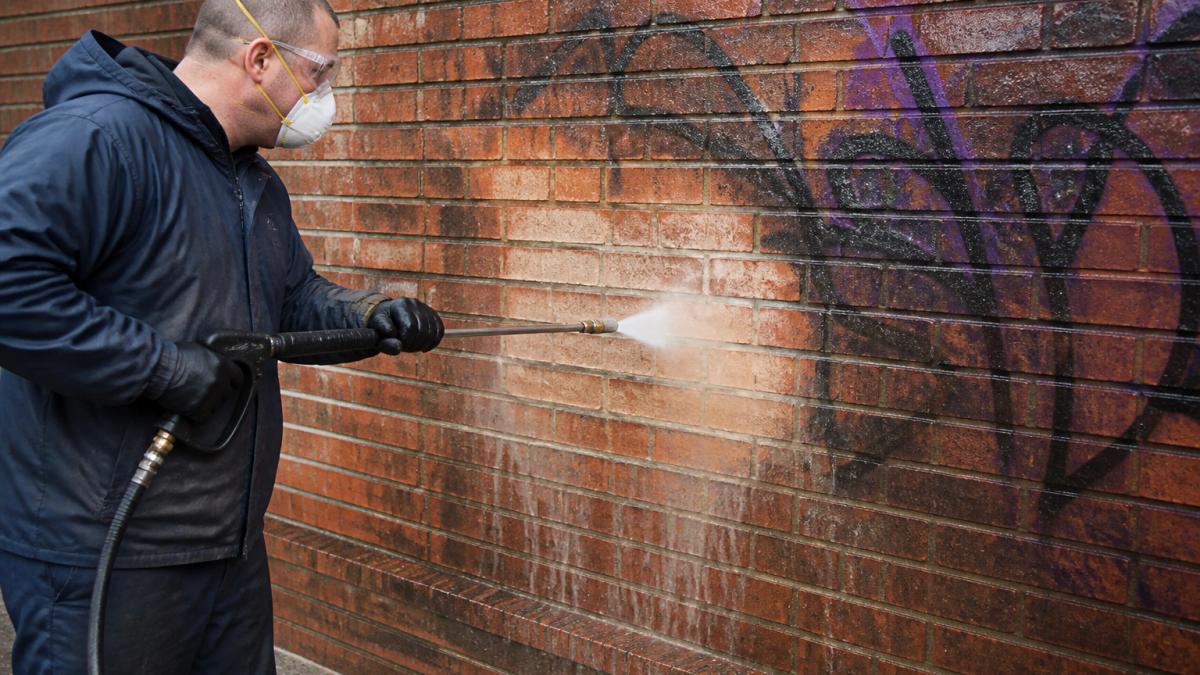
Pressure washing is the step most homeowners reach for first and the one most likely to cause permanent damage.
Why Brick and Pressure Washing Fight Each Other
Brick is hard but porous, and its mortar is softer than the brick itself. A pressure washer strong enough to strip paint off the brick face is usually strong enough to erode mortar joints; once mortar recedes, water sits in the joint, freeze-thaw cycles widen the gap, and the wall starts losing bricks.
When Pressure Washing Is Acceptable, and When It Isn't
Low-pressure washing has a legitimate role: rinsing away remover and loosened paint after a chemical treatment. It is not a standalone removal method for spray paint on brick.
Do not pressure wash if any of the following apply:
- The brick is historic, soft, or already spalling (flaking or crumbling at the face)
- Mortar joints are recessed, sandy, or missing in places
- The wall has existing cracks, efflorescence, or prior water damage
In those cases, a chemical remover with a poultice or a hand-scrubbed approach is the safer path, even though it takes longer.
Safer Alternatives That Still Use Water
If you want the speed of water without the risk, follow this sequence:
- Apply a remover formulated for masonry and let it dwell per the label.
- Agitate with a stiff nylon brush, working in small sections.
- Rinse with a garden hose at household pressure, or a pressure washer on its lowest setting with a wide fan tip.
- Work top to bottom so dirty water does not run over clean brick.
- Divert runoff away from plants, storm drains, and neighboring property.
Once high-pressure washing erodes mortar or spalls a brick face, the damage is not reversible with more cleaning. Repointing and brick replacement are skilled trades, and matching historic mortar is its own project. Test on a hidden area and start at the lowest pressure that does anything at all.
What to Watch For Mid-Job
Stop immediately if you see any of these:
- Sand or grit appearing in the runoff (that is mortar leaving the wall)
- Brick face turning chalky or lighter in color
- Water visibly entering cracks or around window and door frames
Any of these means the method is wrong for this wall, not that you need more pressure.
If the graffiti is on a large wall, a historic structure, or a surface you cannot afford to damage, pressure washing is the wrong tool. A masonry restoration or graffiti-abatement professional can assess the brick, choose a method, and carry the liability if something goes wrong.
How to Remove Old Graffiti From Brick: Multi-Step Approach
Old graffiti bonds deeply to brick and may need multiple applications.
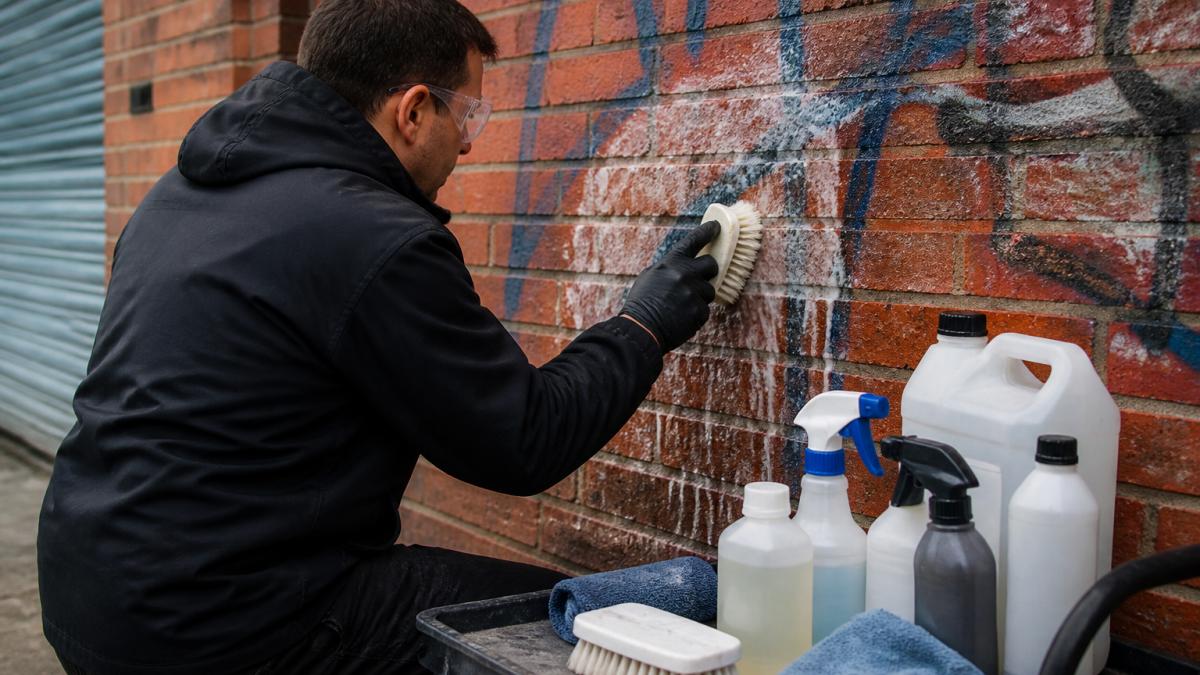
Step 1: Apply Your Chosen Remover
Pour the remover into a spray bottle and spray evenly across the graffiti until the paint is completely wet, coat it without letting it drip. Work top to bottom so gravity helps the remover flow down.
Step 2: Allow Proper Dwell Time
Set a timer, most removers need 15 to 30 minutes, so follow the product instructions exactly. Too short and the paint won't loosen; too long and the remover dries out. Keep the area damp the entire time, spraying lightly if it starts to dry.
Step 3: Scrub the Brick Surface
Use a stiff nylon brush; avoid wire brushes, which damage brick. Scrub in circular motions with firm pressure, without gouging, until the paint starts lifting. Work section by section rather than tackling the whole wall at once. If paint isn't lifting easily, apply more remover and wait longer.
Step 4: Rinse and Wash Away Loosened Paint
Rinse away loosened paint and remover with a garden hose or low-pressure washer, working top to bottom. Rinse thoroughly, leftover remover can damage brick over time. Let the wall dry completely, a few hours depending on weather.
Step 5: Repeat if Necessary
Once dry, check for remaining graffiti; old paint may need a second application.
Repeat the apply, dwell, scrub, rinse steps, multiple treatments are normal for stubborn paint.
Most graffiti comes off in one or two applications. Very old or thick paint might need three.
How to Prevent Graffiti on Brick Walls
Prevention is cheaper than removal, but only with the right barrier, the wrong coating can trap moisture, change the wall's appearance, or fail within a year.
Anti-Graffiti Coatings: The Three Real Options
There are three families of product, and they behave very differently.
Permanent (non-sacrificial) coatings, usually siloxane or acrylic sealers, bond to the brick and resist paint adhesion, so graffiti wipes off with remover and a brush.
Graffiti-resistant paints cover the brick opaquely. They work but permanently change the wall's appearance, making them a last resort for commercial or industrial properties.
Choosing a Coating Without Regret
Before buying, answer these questions:
- Is the brick historic, soft, or already sealed? If yes, get a masonry professional's opinion before applying a permanent coating.
- Do you want the wall to look unchanged? Then you want a breathable, clear, sacrificial product.
- How often are you willing to reapply? If "never," a permanent coating is the only option, and you accept the trade-offs.
A test patch on a hidden area, observed for a full season, tells you more than any label.
The Non-Chemical Deterrents That Actually Work
Coatings are one layer. The rest is environment and habit.
Lighting. Graffiti happens in the dark. Motion-activated lighting on the wall and approaches removes the cover taggers rely on.
Community coordination. Neighborhood cleanups, a shared reporting channel, and consistent follow-through reduce repeat tagging more than any single product.
Disposal and Legal Reality
Prevention and removal both generate waste, and handling it matters.
- Solvent-based removers and their rinse water are typically classified as hazardous waste. Do not pour them down a storm drain, onto the ground, or into a sink. Check your municipal household hazardous waste program for drop-off options.
- Rinse water from water-based or eco-friendly removers still contains paint pigment and brick residue. Divert it away from storm drains, which usually discharge untreated to waterways.
- Contaminated rags, brushes, and drop cloths should be bagged and disposed of according to the product label, not left in the yard.
- Graffiti itself can be evidence. If the tagging is part of an ongoing vandalism problem, photograph it before removal and file a police report. Many jurisdictions have graffiti abatement programs, and some offer removal assistance or reimbursement.
Prevention is a system, not a product. A breathable coating, good lighting, trimmed sightlines, and a fast cleanup habit do more together than any single purchase. And whatever you apply, read the disposal instructions before you open the container, not after.
Common Mistakes to Avoid
Rushing is the biggest mistake. Homeowners apply remover and immediately start scrubbing.
Patience wins, dwell time matters more than scrubbing force.
Skipping the test patch causes regret, always test on a hidden area first.
High-pressure washing damages brick; low pressure is safer and works just as well combined with chemical remover.
Ignoring brick condition leads to disaster, fragile old brick needs gentler treatment, so assess first.
For complex situations, professional help makes sense.
Frequently Asked Questions
Can you use a pressure washer to remove graffiti from brick?
Pressure washers can remove graffiti from brick, but they carry significant risks. High-pressure water can damage the mortar between bricks, erode the brick surface itself, and force water into porous masonry where it may cause interior damage or freeze-thaw damage in winter. Low-pressure washing (below 1500 PSI) combined with chemical removal is safer than high-pressure blasting alone. Always test on an inconspicuous area first and consider professional help for valuable or historic brick.
What is the best graffiti remover for brick?
The best graffiti remover depends on paint type and brick condition. Solvent-based removers work quickly on fresh spray paint but require careful handling and proper ventilation. Eco-friendly, biodegradable options are safer for residential use and the environment, though they may need longer dwell time. For stubborn or old graffiti, a combination approach, chemical remover followed by gentle scrubbing, often works better than any single product. Always test your chosen remover on a small, hidden area first.
How do you remove old or dried graffiti from brick without damaging it?
Old graffiti requires patience and the right method. First, identify your brick type and age, older brick is more fragile. Apply a chemical graffiti remover and allow adequate dwell time (typically 15-30 minutes) before scrubbing gently with a soft-bristle brush. Avoid high-pressure washing. For stubborn paint, repeat the process rather than increasing pressure. If the brick shows signs of damage or the graffiti won't budge after multiple attempts, hire a professional to prevent costly surface deterioration.
How can you prevent graffiti from appearing on brick walls?
Prevention starts with visibility and maintenance. Keep brick walls well-lit and clear of hiding spots. Apply anti-graffiti protective coatings, sacrificial sealers that allow paint to be removed more easily, or permanent coatings that prevent paint adhesion. Regular cleaning removes tags before they become eyesores. Community involvement, such as organized cleanup efforts and neighborhood watch programs, also deters graffiti. For high-risk areas, consider murals or community art as a deterrent, as taggers often avoid spaces with legitimate artwork.
Graffiti doesn't have to stay on your brick walls. The right approach removes paint safely and preserves your property's appearance. Start with the right tools, test first, and be patient with dwell time. For stubborn graffiti or delicate brick, Soul Cleanse has the expertise and equipment to handle it. Get a quote today and restore your brick to its original look.