 blog
blog
Best Pressure Washing Equipment for Stubborn Stains
Table of Contents
- Pressure Washing vs Power Washing for Driveways
- Understanding PSI and Flow Rate for Stubborn Stain Removal
- Best Surface Cleaner for Concrete Stains
- Chemical Compatibility Guide for Pressure Washers
- Benefits of Professional Pressure Washing Services
- Troubleshooting Common Pressure Washer Failures
- Safety and Maintenance for Long-Term Performance
- Frequently Asked Questions
Last Updated: September 23, 2026
Pressure Washing vs Power Washing for Driveways
The terms get used interchangeably, but they're not the same thing. Understanding the difference matters when you're tackling stubborn stains on concrete, brick, or asphalt. Pressure washing uses hot water, while power washing relies on cold water. For most residential driveways dealing with oil stains, mold, or algae growth, hot water can be more effective because the heat breaks down organic matter and grease.
Cold water power washing can push stains deeper into porous concrete if pressure is too high, while hot water pressure washing can help lift stains.
Oil stains, mold, and mildew can respond well to heat. For stubborn stains, pressure washing with the right nozzle attachment can be effective.
Understanding PSI and Flow Rate for Stubborn Stain Removal
PSI measures water force; GPM measures volume. Together they determine cleaning power. Most residential equipment operates within a certain PSI range, while commercial-grade equipment can reach higher PSIs.
Higher PSI isn't always better; high PSI on aged concrete can etch the surface permanently. A machine with appropriate PSI and GPM can deliver effective cleaning.
For oil stains and rust, certain PSI ranges are recommended. For mold and mildew, specific PSI with hot water and detergent can be sufficient. An adequate flow rate is important for effective stain removal.
Surface-Specific PSI Damage Thresholds
Concrete tolerates certain PSI ranges; brick and stone should not exceed a specific PSI to avoid fracturing mortar; wood siding requires a maximum PSI to prevent splintering and water damage.
Nozzle distance matters as much as PSI: at 12 inches a 3,000 PSI stream is aggressive; at 24 inches it's gentler. The best pressure washing equipment for stubborn stains includes adjustable pressure settings and wand extensions for controlled cleaning intensity.
Best Surface Cleaner for Concrete Stains
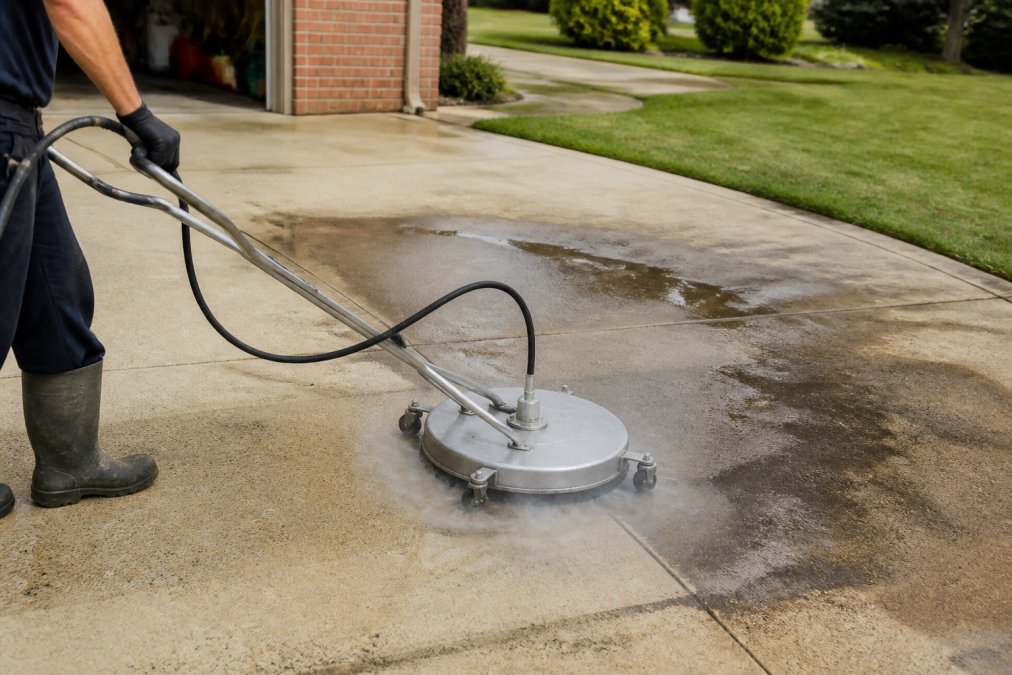
Surface cleaners are rotating attachment heads that distribute pressure evenly across a wide cleaning path, eliminating streaking and uneven cleaning that occurs with hand-held wands.
Quality models cover a wide cleaning path with rotating nozzles that can maintain steady pressure and help prevent etching from prolonged single-stream contact.
Choose models with quick-connect fittings and onboard soap tanks for applying degreaser directly through the attachment before pressure washing.
Surface Cleaner Attachments for Driveways and Patios
For concrete driveways, a surface cleaner at appropriate PSI can deliver professional results. Patio stones and pavers can benefit from specific PSI to protect joints.
Rotating nozzles can deliver pressure in a way that helps reduce etching. The best pressure washing equipment for stubborn stains includes a quality surface cleaner as a core component.
Most professional-grade surface cleaners work with standard hoses and quick-connect couplings.
Pre-Soaking and Chemical Solutions for Maximum Results
Pre-soaking with detergent breaks down stains at the molecular level. Degreaser works on oil and grease; surfactant-based cleaners kill mold and mildew before pressure washing removes dead material.
The ideal approach is to apply the chemical solution, let it sit for a period, then pressure wash. This dwell time allows the detergent to work on the stain's bond. Rushing straight to pressure washing without pre-soaking can mean the stain only partially lifts.
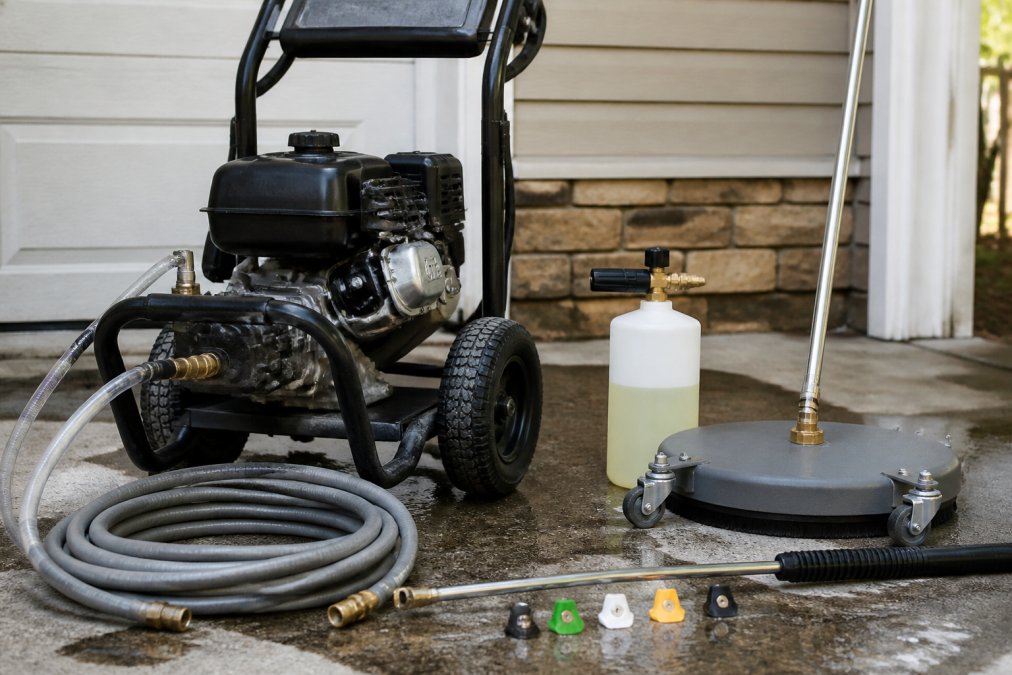
When selecting cleaning solutions, match them to the stain type. Oil stains need degreaser. Rust stains require an acid-based rust remover. Mold and mildew respond to biocides and surfactants. The best pressure washing equipment for stubborn stains includes an onboard soap tank or foam cannon that applies these solutions evenly across the surface before pressure washing.
Chemical Compatibility Guide for Pressure Washers
Not all cleaning chemicals are safe for all pressure washer equipment. Some degreasers corrode pump seals and hose linings. Others leave residue that clogs nozzles. Understanding which chemicals work with your equipment prevents damage and ensures effective cleaning.
Most pressure washers can handle mild detergents and commercial-grade degreasers designed for pressure washing. Avoid bleach-based cleaners in equipment with aluminum components, as bleach causes corrosion. Acid-based rust removers require stainless steel or ceramic pump components; standard brass pumps will corrode.
When using any chemical, always run clean water through the system after you're finished. This flushes residue from the pump, hose, and nozzles, preventing buildup that reduces performance over time. If your equipment has an onboard soap tank, empty it completely and rinse it thoroughly before storing the machine.
The best practice is to use only cleaning solutions specifically labeled as compatible with pressure washers. Generic household cleaners or industrial-strength chemicals may damage seals, corrode internal components, or reduce the lifespan of your equipment significantly.
Benefits of Professional Pressure Washing Services
DIY pressure washing works for light cleaning, but stubborn stains often require equipment, expertise, and chemical knowledge that go beyond what most homeowners have. Professional services bring several advantages. They have commercial-grade equipment with higher PSI, better temperature control, and specialized attachments designed for different surfaces and stain types.
Professional operators understand surface-specific PSI thresholds and know how to adjust pressure, distance, and nozzle type to remove stains without causing damage. They carry multiple cleaning solutions matched to different stain types and know which chemicals work best for each situation. They also carry insurance and liability coverage, protecting your property if something goes wrong.
For homeowners preparing to sell, professional pressure washing increases curb appeal and can add measurable value to the asking price. For business owners, regular professional cleaning maintains storefronts and building exteriors, which directly impacts customer perception and foot traffic. Soul Cleanse provides this service across the region, handling everything from stubborn driveway stains to mold removal on siding and roofs, with guaranteed satisfaction and the expertise to protect your surfaces while delivering results.
The time savings alone justify professional services. What takes a homeowner an entire weekend takes a professional crew a few hours, and the results are more consistent and longer-lasting.
Troubleshooting Common Pressure Washer Failures
When pressure washers underperform, the issue is usually one of a few things. Low pressure often means a clogged nozzle, a kinked or damaged hose, or insufficient water supply from your source. Check nozzles first, they're cheap and easy to replace. Inspect hoses for kinks or punctures. Make sure your water source has adequate flow; if you're drawing from a well, the pump may not be pulling enough water.
Loss of pressure during use typically signals a worn pump. Pumps wear over time, especially if the machine runs dry or if debris gets into the intake. A worn pump can't maintain pressure and should be serviced or replaced.
Uneven cleaning or streaking usually means the nozzle is worn or the wand is moving too fast. Replace worn nozzles, they're inexpensive and make a huge difference. Slow down your movement across the surface to allow the pressure stream time to break the stain's bond.
If the machine won't start or loses power, check fuel quality (for gas models), battery charge (for electric models), and whether the engine or motor is getting proper cooling airflow. Many pressure washers have thermal shutoffs that activate if the equipment gets too hot; let it cool for 30 minutes before restarting.
Safety and Maintenance for Long-Term Performance
Pressure washers are powerful tools that demand respect. The force of a 3,000 PSI stream can cause serious injury if it contacts skin directly. Always wear eye protection, closed-toe shoes, and long pants when operating a pressure washer. Keep bystanders at least 20 feet away from the cleaning area.
Never point the wand at people, pets, or windows. Never pressure wash while standing on a ladder or unstable surface. Never leave the machine running unattended. These are basic safety practices that prevent accidents and injuries.
Maintenance extends equipment life and ensures consistent performance. After each use, flush the system with clean water to remove detergent and debris. Check hoses for damage before each use. Inspect nozzles and replace them if they're worn or cracked.
| Stain Type | Recommended PSI | Water Temperature | Best Pre-Treatment |
|---|---|---|---|
| Oil and grease | 2,500-3,500 | Hot (130-180°F) | Degreaser |
| Mold and mildew | 1,500-2,500 | Hot (130-180°F) | Biocide or surfactant |
| Rust stains | 2,000-3,000 | Hot (130-180°F) | Acid-based rust remover |
| Algae buildup | 1,500-2,500 | Hot or cold | Algaecide or biocide |
| General dirt | 2,000-3,000 | Hot or cold | Mild detergent |
Frequently Asked Questions
Frequently Asked Questions
What PSI is required to remove stubborn stains from concrete?
Stubborn concrete stains can require specific PSI for effective removal. Oil stains, rust, and efflorescence typically need a certain range, while lighter stains may respond to lower PSI. Start at lower settings and increase gradually to avoid surface etching or damage. A rotary nozzle or turbo nozzle can concentrate pressure effectively, potentially allowing for lower PSI while achieving good results.
Are surface cleaners better than standard nozzles for tough stains?
Yes, surface cleaner attachments provide superior results for large, flat surfaces like driveways and patios. They deliver consistent pressure across a wider cleaning path, prevent streaking, and reduce the risk of substrate damage from concentrated spray. For stubborn stains covering significant areas, a surface cleaner with proper PSI and flow rate (GPM) outperforms handheld nozzles in both efficiency and finish quality.
What chemical solutions should be paired with pressure washing equipment?
Pre-soaking with appropriate detergents and surfactants maximizes stain removal. Degreasers work for oil stains, specialized rust removers for rust deposits, and mild detergents for general dirt and mildew. Always verify chemical compatibility with your equipment and the substrate before application. Professional-grade solutions designed for pressure washers can deliver effective results.
How does professional pressure washing preserve exterior surfaces compared to DIY attempts?
Professional pressure washing services combine proper PSI settings, appropriate nozzle selection, chemical knowledge, and technique to clean effectively without causing damage. Professionals understand surface-specific thresholds, helping to prevent etching on concrete, wood damage, or paint removal. They use commercial-grade equipment with pressure regulation and flow control, which can help extend your property's lifespan while achieving effective results.