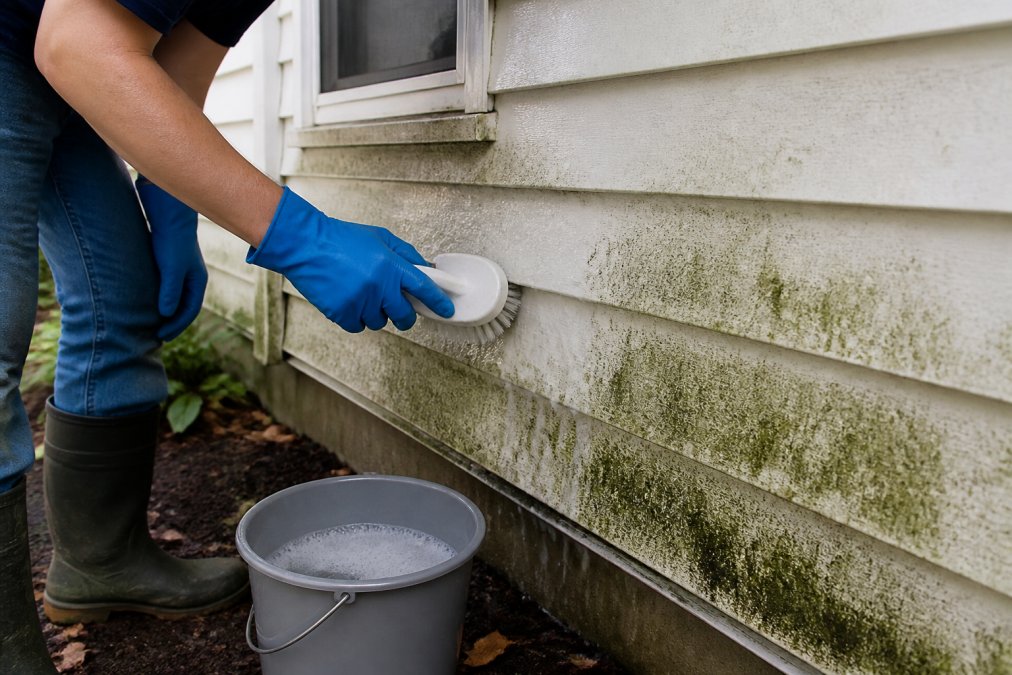
 how-to
How to Safely Remove Mold from House Siding
Table of Contents
- Step 1: Gather Mold Removal Safety Gear Before You Start
- Step 2: Identify Mold vs. Mildew and Assess Siding Material
- Step 3: Choose the Best Mold Cleaner for Vinyl Siding and Other Surfaces
- Step 4: Pressure Washing vs. Soft Washing for Mold Removal
- Step 5: Apply Cleaner, Scrub, and Rinse Without Damaging Siding
- Step 6: How to Prevent Mold on House Siding Long-Term
- Frequently Asked Questions
Last Updated: September 14, 2026
Step 1: Gather Mold Removal Safety Gear Before You Start
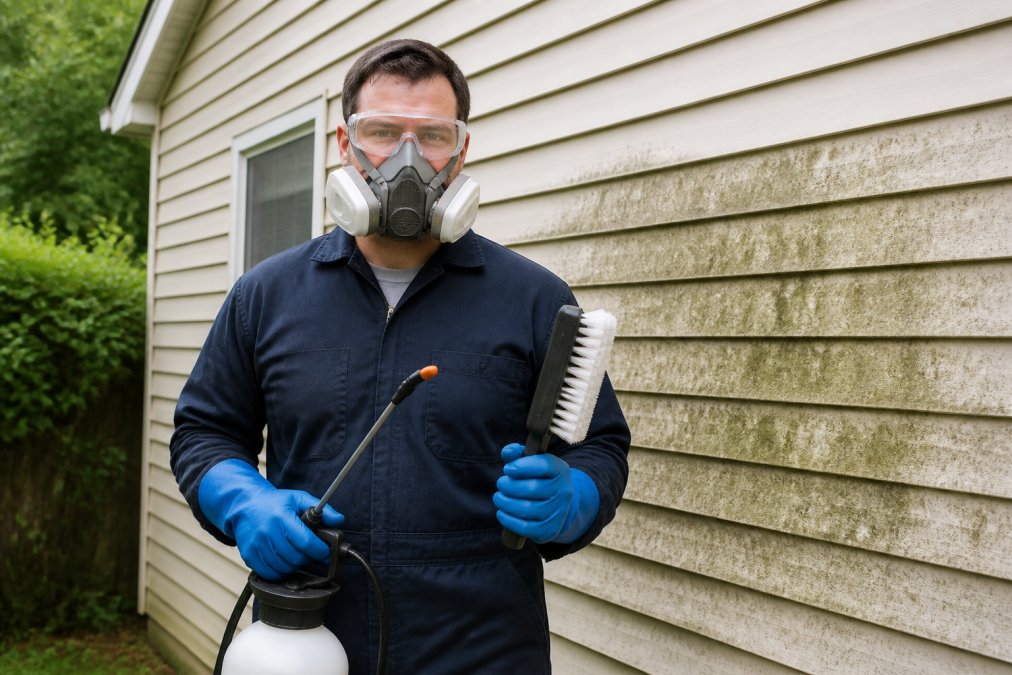
Learning how to safely remove mold from house siding starts with protecting yourself, not mixing chemicals. Mold spores become airborne the moment you disturb a colony, and a garden hose will not keep them out of your lungs. Suit up before you touch a scrub brush.
Essential Protective Equipment for Exterior Mold Cleaning
At minimum, you need:
- Protective eyewear that seals against splashes, not basic sunglasses
- A respirator rated for mold spores, not a dust mask
- Rubber gloves that extend past the wrist
- Long sleeves and pants you can wash separately afterward
- Rubber boots if you will be standing on wet ground
Ladder Safety and Working at Heights
Falls kill more homeowners during exterior cleaning than any chemical exposure (the CDC). If your mold is on second-story siding, set the ladder on firm, level ground, maintain three points of contact, and never overreach sideways. The OSHA ladder safety guidance is written for job sites, but the physics apply to your driveway too.
Step 2: Identify Mold vs. Mildew and Assess Siding Material
Mold and mildew look similar but require different treatments. Mildew is a powdery gray or white surface fungus; mold is deeper, showing up black, green, or brown with a fuzzy texture. On siding, what most homeowners call "mold" is usually a mix of algae, mildew, and fungi feeding on dirt and moisture.
Here is how to tell them apart before you buy anything:
| Feature | Mildew | Mold |
|---|---|---|
| Color | Gray or white | Black, green, brown |
| Texture | Powdery, dry | Fuzzy, slimy |
| Smell | Musty but mild | Strong, earthy |
| Growth pattern | Flat patches | Raised clusters |
| Typical fix | Light cleaner + rinse | Longer dwell time + scrubbing |
Material-Specific Risks: Vinyl, Fiber Cement, Wood, and Brick
Your siding material determines how you clean it, and what you should never put on it. Most guides treat every wall the same, which is how homeowners end up with chalky vinyl, etched fiber cement, or stripped paint.
Vinyl siding. Vinyl is the most forgiving surface for mold removal, but it has two hard limits. Diluted bleach is generally safe, but it dulls the surface and accelerates chalking if left to dry on the panel. Vinyl also softens in direct sun, a dark panel in full afternoon sun can warp or streak permanently under a pressure washer nozzle. Clean vinyl in the shade or on an overcast day, and never exceed about 1,300 PSI even when soft washing.
Fiber cement. Fiber cement (the James Hardie-style boards) is dimensionally stable but porous at cut edges and penetrations. Bleach is generally acceptable on factory-finished boards, but it attacks the color layer on painted boards if the solution dwells too long. The bigger risk is water intrusion: high pressure drives water into cut ends and behind butt joints, feeding the mold you are trying to kill. Keep pressure under roughly 1,500 PSI and direct the stream downward and across the board, never into a seam. Fiber cement also contains silica, dry-scrubbing releases respirable crystalline silica, so wet methods and a respirator matter here more than on any other siding type.
Wood siding. Wood is the material most likely to be permanently damaged by a mold removal attempt. Bleach on bare or lightly painted wood raises the grain, strips natural oils, and leaves a gray patch that will not take stain evenly. High pressure is worse, it drives water into the grain, opens checks, and creates the moisture reservoir rot and mold need. Use oxygen bleach (sodium percarbonate) or a borate-based cleaner, keep pressure at or below a garden-hose rinse, and re-seal or re-stain within the season.
Brick and mortar. Brick tolerates bleach and moderate pressure, but mortar joints do not. Mortar is softer and erodes under a direct high-pressure stream, opening the joints to water. Use low pressure, a soft-bristle brush, and a cleaner that will not leave salt residue that pulls moisture into the masonry. Never use a wire brush on brick, it scratches the face permanently.
Stucco. Stucco is porous and painted, so it behaves like a cross between fiber cement and wood: bleach is usually fine on acrylic-finished stucco, but pressure is not. Keep it under about 500 PSI and let the cleaner do the work.
Step 3: Choose the Best Mold Cleaner for Vinyl Siding and Other Surfaces
The best mold cleaner for vinyl siding is a diluted sodium hypochlorite solution, applied carefully and rinsed thoroughly. Oxygen bleach is gentler for painted wood and fiber cement; vinegar handles light mildew but struggles against established mold colonies.
Bleach vs. Vinegar: Which Kills Mold on Siding?
Bleach kills mold faster and penetrates porous surfaces better than vinegar. Vinegar is safer for plants and works on mild surface mildew, but for heavy black mold stains on vinyl siding, bleach-based solutions are the practical choice.
A word of caution: never mix bleach with ammonia or with vinegar. The combination releases toxic gas.
How to Mix a Safe Bleach Solution
For general exterior cleaning, mix one part household bleach to three parts water in a garden sprayer. A few drops of mild dish soap help it cling to vertical surfaces. Trisodium phosphate boosts cleaning power on stubborn stains, but check it suits your siding material first.
According to the EPA guidance on safe cleaning product use, you should always ventilate the area and avoid letting runoff reach storm drains or garden beds.
Step 4: Pressure Washing vs. Soft Washing for Mold Removal
Pressure washing vs soft washing for mold comes down to PSI and risk. Pressure washing blasts debris off hard surfaces like concrete. Soft washing uses low pressure, around 500 PSI or less, plus cleaning solution and dwell time to kill mold at the root.
For siding, soft washing is almost always the safer choice. High pressure forces water behind panels, strips paint, and etches fiber cement.
When to Use a Pressure Washer and When to Soft Wash
- Pressure washer: concrete driveways, brick patios, stone walkways
- Soft wash: vinyl siding, fiber cement, painted wood, stucco, roofs
- Never pressure wash: aged wood siding, loose mortar, window seals
Soul Cleanse uses gentle but highly efficient methods precisely because aggressive pressure causes damage that shows up months later, not immediately.
Step 5: Apply Cleaner, Scrub, and Rinse Without Damaging Siding
Apply your cleaner from the bottom up, then let it sit. Dwell time is the step everyone rushes. Most cleaning solutions need 5 to 10 minutes to break down mold and mildew stains. If the solution dries before you rinse, it stops working.
Scrub stubborn patches with a soft-bristle brush, never steel wool or stiff brushes on vinyl or painted surfaces. Work in sections of about 10 feet so the solution does not dry out before you rinse.
Rinse from the top down with a garden hose or soft wash nozzle. Rinse thoroughly, because leftover cleaner can bleach landscaping and leave streaks on siding.
Step 6: How to Prevent Mold on House Siding Long-Term
Preventing mold on house siding comes down to managing moisture and organic buildup. Mold needs water, food, and a surface, remove any one and it stops returning. But first, deal with this job's runoff: the same bleach that kills mold on your wall will kill your landscaping if it reaches the beds.
Protect Landscaping From Cleaning Runoff
This is the step almost every guide skips. Sodium hypochlorite runoff is toxic to plants, fish, and soil biology at concentrations well below what you use on siding. A few practical rules:
- Pre-wet plants before you start. Saturate the soil and foliage in beds within about 10 feet of the wall with plain water. Wet soil and wet leaves dilute the runoff and reduce uptake.
- Cover what you cannot move. Drape plastic sheeting over shrubs, and weight the edges so it does not blow. Move potted plants and lawn furniture out of the drip line entirely.
- Rinse again immediately after. As soon as you finish a wall, flood the beds with fresh water, do not wait until the end of the job. The longer bleach sits on soil, the more it moves into the root zone.
- Never let runoff reach storm drains, creeks, or ponds. Most municipal storm systems discharge untreated to local waterways, and chlorine is acutely toxic to aquatic life. If your downspouts or grading carry runoff toward a drain, block or redirect it for the duration of the job.
- Do not clean on a windy day. Overspray drift reaches plants you never intended to touch, and it is the most common cause of "mystery" plant death after a siding wash.
If you use a bleach-based cleaner, a garden hose and a five-gallon bucket of fresh water are your most important landscaping tools. To avoid the runoff question entirely, oxygen bleach (sodium percarbonate) breaks down into water, oxygen, and soda ash and is far gentler on beds, at the cost of slower dwell time and weaker performance on heavy black mold.
Stop the Moisture That Feeds Regrowth
Once the wall is clean and the beds are safe, remove the conditions mold needs to come back:
- Trim shrubs and trees back at least two feet from siding so air moves across the wall and sun reaches it
- Clear gutters so water does not overflow down the walls and soak the sheathing behind the panels
- Fix leaky hose bibs, gutters, and downspouts promptly, a slow drip behind siding is a mold farm
- Redirect downspout runoff at least four to six feet away from the foundation
- Keep the north-facing wall in mind: it dries slowest and will always be the first to regrow
- Wash siding once or twice a year before mold establishes, rather than waiting for visible staining
Consider a Preventive Siding Treatment
For walls that regrow mold every year, a preventive treatment is worth the cost. Two options are common:
- A residual mildewcide or algaecide wash applied after cleaning. These leave a thin film that inhibits new growth for a season or more. They are not a substitute for cleaning, and they do not fix a moisture problem, but they buy time between washes.
- A clear water-repellent sealer on wood, fiber cement, and porous masonry. Sealing slows water absorption, which starves surface mold and reduces the freeze-thaw damage that opens new cracks. Sealer needs to be reapplied periodically, and it should never be applied over active mold, clean first, then seal.
This is where preventative maintenance pays for itself. A light annual exterior cleaning costs far less than replacing rotted siding or repainting a permanently stained wall, and it keeps the runoff problem small enough that a hose and a bucket handle it.
Soul Cleanse offers scheduled exterior cleaning for homeowners and property managers who would rather prevent the problem than fight it every spring. If you manage multiple rental properties or commercial storefronts, a recurring schedule keeps every building looking maintained without you lifting a ladder.
Frequently Asked Questions
What kills mold on house siding?
A bleach solution or a commercial mildewcide containing sodium hypochlorite kills mold spores on siding. Mix one part bleach with three parts water, apply with a garden sprayer, let it dwell for 10 to 15 minutes, then rinse thoroughly. For vinyl siding, oxygen bleach is a safer alternative that cleans without fading color. Always test a small area first and wear protective eyewear and a respirator.
Does Dawn dish soap kill black mold?
Dawn dish soap does not kill mold; it only removes surface dirt and some mildew stains. To actually kill black mold spores on siding, you need a fungicide or bleach-based cleaner. Dish soap can be used as a pre-treatment to loosen grime before applying a mold-killing solution, but it will not stop mold from returning. Pair it with a mildewcide for lasting results.
Which is better for killing mold, bleach or vinegar?
Bleach kills mold faster and is more effective on non-porous surfaces like vinyl and fiber cement siding. Vinegar works on porous surfaces and is safer for landscaping, but it takes longer to kill spores. For exterior siding, a bleach solution or a commercial mold cleaner designed for outdoor use delivers the best results. Vinegar is a good follow-up for mild mildew on wood.
How often should you clean mold off house siding?
Clean mold off house siding once a year, ideally in spring, and spot-treat any visible growth as soon as it appears. Homes in humid climates or shaded areas may need cleaning every six to eight months. Regular preventative maintenance, such as trimming vegetation away from siding and checking for leaks, reduces how often mold returns and protects your exterior surfaces.